


You may be considering a conservation easement because you want to protect your ranch, create liquidity, or make an estate-planning move. But which path makes sense: NRCS conservation easements, a Florida state program, or a private land trust?
The answer depends on what you want to protect, which rights you need to keep, how quickly you need an agreement, and whether you are prepared to place long-term restrictions on the property.
For landowners in Sarasota, Charlotte, and surrounding central and southern Florida counties, the choice often involves working ranches, pine flatwoods, dry prairie, wetlands, and land facing development pressure. A conservation easement can function like a gated community for wildlife: the land remains privately owned, working operations continue, and development rights are retired. But the gate also represents real legal limits. Once the easement is recorded, future owners must follow it.

Photo credit: UF/IFAS Extension.
The Short Answer: Which Option Fits?
There are two broad paths. The first is the federal Agricultural Conservation Easement Program, ACEP, administered by the USDA Natural Resources Conservation Service, NRCS. It has two components relevant to Florida landowners: Agricultural Land Easements, ACEP-ALE, for working agricultural land, and Wetland Reserve Easements, ACEP-WRE, for wetland protection and restoration.
The second path is a ranch conservation easement through a state, county, or private program, such as Florida's Rural and Family Lands Protection Program, RFLPP, a county government, or a private land trust.
One important note before comparing the two: these paths are not always separate. The federal Agricultural Conservation Easement Program may still require a partner from the second path, such as a land trust, state agency, or local government, to apply for and hold the easement. That partnership is explained in more detail later in this article.
The table below summarizes how the two paths compare. Each term is explained in more detail in the sections that follow.
| Consideration | Federal NRCS ACEP-ALE / ACEP-WRE | Ranch conservation easements through state, county, or private programs |
|---|---|---|
| Primary purpose | Protect working agricultural land or restore and protect wetlands | Protect ranches, farms, wildlife corridors, water resources, and open space |
| Easement holder | Usually an eligible entity for ACEP-ALE; NRCS holds ACEP-WRE easements | State agency, county, or private land trust, depending on the program |
| Payment structure | Program cost-share and appraisal-based valuation | Negotiated purchase, appraisal-based payment, donation, or bargain sale |
| Term | ACEP-ALE is generally perpetual; ACEP-WRE may be permanent or 30-year | RFLPP is permanent; private and county terms depend on the agreement |
| Application timing | Continuous signup, but applications are ranked during announced batching periods | RFLPP uses defined application cycles; private programs vary |
| Best fit | Working agricultural land meeting federal eligibility and conservation priorities | Ranches with strong landscape, agricultural, wildlife, water, or estate-planning value |
This is not a choice between “conservation” and “agriculture.” A well-designed easement can support both. However, it can never make everyone happy. The conservation holder needs enforceable protections, while you need enough flexibility to keep the operation viable.
What Are NRCS Conservation Easements?
The federal Agricultural Conservation Easement Program (ACEP) has two major components relevant to Florida landowners.
ACEP-ALE: Agricultural Land Easements
ACEP-ALE is designed for working cropland, grassland, pasture, and ranch land. It limits non-agricultural uses while allowing the land to remain in production.
In Florida, you generally do not apply to NRCS for ALE entirely on your own. You work with an eligible entity, such as a land trust, state agency, local government, or similar partner. That entity submits the application and typically holds the easement.
Eligibility and ranking may consider:
- Productive soils
- Protection of grazing uses
- Risk of conversion to residential or commercial development
- Agricultural infrastructure and market access
- Wildlife, water, and other conservation values
- USDA Farm Service Agency farm records
- Compliance with wetland and highly erodible land requirements
- A conservation or agricultural land easement plan
NRCS accepts applications on a continuous basis, but continuous signup does not mean immediate funding. Florida applications are grouped into ranking or batching periods. Applications submitted after a cutoff may be deferred to a later funding cycle.
Review the USDA NRCS ACEP program page and Florida ACEP information for current requirements and deadlines.
ACEP-WRE: Wetland Reserve Easements
ACEP-WRE is focused on protecting, restoring, and enhancing wetlands on eligible agricultural land. In this case, private landowners generally apply directly to NRCS.
WRE may be a better fit when the core objective involves:
- Restoring degraded wetlands
- Protecting wetland functions
- Improving wildlife habitat
- Managing organic or high-carbon soils
- Reconnecting wetlands to the broader watershed
The operational implications can be different from ALE. A WRE easement may include restoration activities, water-management requirements, or restrictions within restored wetland areas. Do not assume that a WRE agreement will allow the same level of grazing, mowing, fencing, or land alteration across the entire property.
What Are Ranch Conservation Easements?
“Ranch conservation easement” is a practical description rather than one single program. The easement may be held by:
- The State of Florida
- A county government
- A private land trust
- A conservation organization working with a state or federal partner
Florida’s Rural and Family Lands Protection Program (RFLPP) is one of the most important state options for agricultural landowners. It is designed to protect important agricultural lands while keeping them in economically viable production.
The FDACS RFLPP program page provides program information and application guidance.
RFLPP cycles are not continuous. The Florida Department of Agriculture and Consumer Services announces a defined application window and deadline. Notices must be published through the Florida Administrative Register, generally with advance notice before the closing date. Applications are reviewed for completeness, undergo technical review, and are ranked before final approval.
Private land trusts can offer a different path. In the Sarasota and Charlotte region, organizations such as the Conservation Foundation of the Gulf Coast and Conservation Florida may be relevant starting points, depending on the property and conservation goals.
How Are Payments Calculated?
This is one of the most misunderstood parts of conservation easements.
The value is usually not based simply on the number of acres. Instead, the central question is:
What is the property worth before the easement, and what is it worth after the development restrictions are recorded?
The difference is commonly called the value of the conservation easement or development rights.
Sale, donation, and bargain sale
A landowner may pursue one of three basic structures:
- Full-value sale: The holder purchases the easement for an agreed amount supported by appraisal and program rules.
- Donation: You convey the easement without receiving payment and may pursue a charitable deduction if all IRS requirements are satisfied.
- Bargain sale: You receive less than the easement’s fair market value and treat the transaction as partly a sale and partly a charitable contribution.
NRCS programs generally rely on program-specific appraisals, eligibility standards, and payment limitations. The entity holding an ACEP-ALE easement may negotiate the purchase with you while NRCS provides cost-share assistance to the eligible entity. WRE payments are also governed by NRCS valuation and program procedures.
State, county, and private programs may use different funding structures. The payment may be based on an appraisal, a negotiated offer, available appropriations, or a combination of public and private funds.
An appraisal is not a promise of payment. Funding availability, ranking, program eligibility, title review, and the final easement terms all matter.
Which Rights Are You Giving Up, and Which Can You Keep?
The easement deed is the most important document in the process. It should clearly identify both the rights conveyed and your reserved rights.
Commonly conveyed rights include:
- Subdivision and residential development
- Commercial or industrial development
- Intensive non-agricultural uses
- Certain road, utility, or infrastructure rights
- Activities that damage wetlands, water resources, or habitat
Rights that may be reserved, if consistent with the easement’s conservation purpose, include:
- Cattle grazing and pasture rotation
- Hay production and crop production
- Ranch roads, fences, ponds, and existing structures
- Hunting and hunting leases
- Forestry or timber management
- Prescribed fire
- Wildlife habitat management
- Maintenance of homes and agricultural facilities
A prescribed fire program on a three- to five-year burn interval may remain possible, but the deed must preserve the right and identify applicable approvals. Likewise, hunting leases may continue, but only if hunting and leasing rights are reserved and operated consistently with the easement and state law.
Private ownership does not mean public access. The American public-trust model does not give the public permission to trespass, hunt, fish, or enter private land without the owner’s consent. You retain the right to manage your property, control access, lease hunting rights, and make property-management decisions within applicable regulations and the easement terms.
IRS Requirements When You Claim a Charitable Deduction
If you claim a deduction for a donated or bargain-sale easement, involve your tax advisor and attorney before signing anything.
A qualified conservation contribution generally requires:
- A qualified real property interest, usually a restriction granted in perpetuity
- A qualified organization with the resources and commitment to enforce the easement
- A recognized conservation purpose
- A qualified appraisal
- Form 8283, including Section B for larger noncash contributions
- A contemporaneous written acknowledgment from the recipient organization
The IRS requires a qualified appraisal for noncash charitable contributions over $5,000. If the claimed deduction exceeds $500,000, the appraisal generally must be attached to the return.
The IRS also distinguishes the appraisal from the donee’s written acknowledgment. Form 8283 does not replace the separate written acknowledgment requirement.
Review IRS Publication 526, the IRS conservation easement guidance, and the Conservation Easement Audit Technique Guide. Be especially cautious of promoters offering deductions that appear disconnected from the property’s real economics.
When Is an Easement Not the Right Call?
A conservation easement may not fit if you:
- Expect to subdivide or develop the property later
- Need unrestricted flexibility for future homes, roads, utilities, or commercial uses
- Cannot accept annual or periodic compliance monitoring
- Need a fast transaction or immediate payment
- Have unresolved title, mortgage, boundary, or ownership issues
- Operate in a way that conflicts with the proposed conservation restrictions
- Are pursuing the easement mainly for a tax deduction
The easement may also be a poor fit if your family has not discussed the consequences. A future owner may inherit the ranch, but not the right to undo the easement.
A Practical Florida Action Plan
Start with your operation, not the program.
- Map your current and future uses. Identify grazing areas, homesites, barns, roads, wetlands, hunting areas, burn units, and possible family needs.
- Confirm agricultural status. Contact the Sarasota County Property Appraiser or Charlotte County Property Appraiser about agricultural classification and Greenbelt documentation.
- Establish USDA records. Use the USDA Service Center Locator to locate the appropriate NRCS and Farm Service Agency office.
- Compare programs. Review ACEP-ALE, ACEP-WRE, RFLPP, county programs, and private land trusts.
- Prepare baseline information. Assemble surveys, title documents, maps, soils information, management plans, agricultural records, and habitat data.
- Negotiate the deed language early. Do not wait until the closing stage to discuss burn intervals, grazing, hunting leases, structures, roads, and family residences.
- Coordinate legal, tax, and ecological review. An easement is a legal instrument, a financial transaction, and a long-term land-management plan.
Natural Resources Associates can help you evaluate wildlife habitat, ranch management, wetlands, prescribed fire, restoration, and the practical interaction between agricultural operations and conservation requirements through our wildlife and land management services.
Bottom Line
NRCS conservation easements may be the strongest fit when your property aligns with federal agricultural or wetland priorities and you can work within NRCS ranking, documentation, and timing requirements.
Ranch conservation easements through RFLPP, counties, or private land trusts may provide a better fit when the primary goal is protecting an operating Florida ranch, wildlife corridor, water resource, or family land base through a more customized transaction.
Neither path should be treated as a quick grant application. These projects can require extensive appraisal, title, environmental, legal, and agency review. Start early, often well before a planned sale, refinancing, development decision, or estate transfer.
If you are evaluating conservation easements in Sarasota, Charlotte, or surrounding central and southern Florida counties, contact Natural Resources Associates to discuss your land, your operation, and the rights you need to keep.
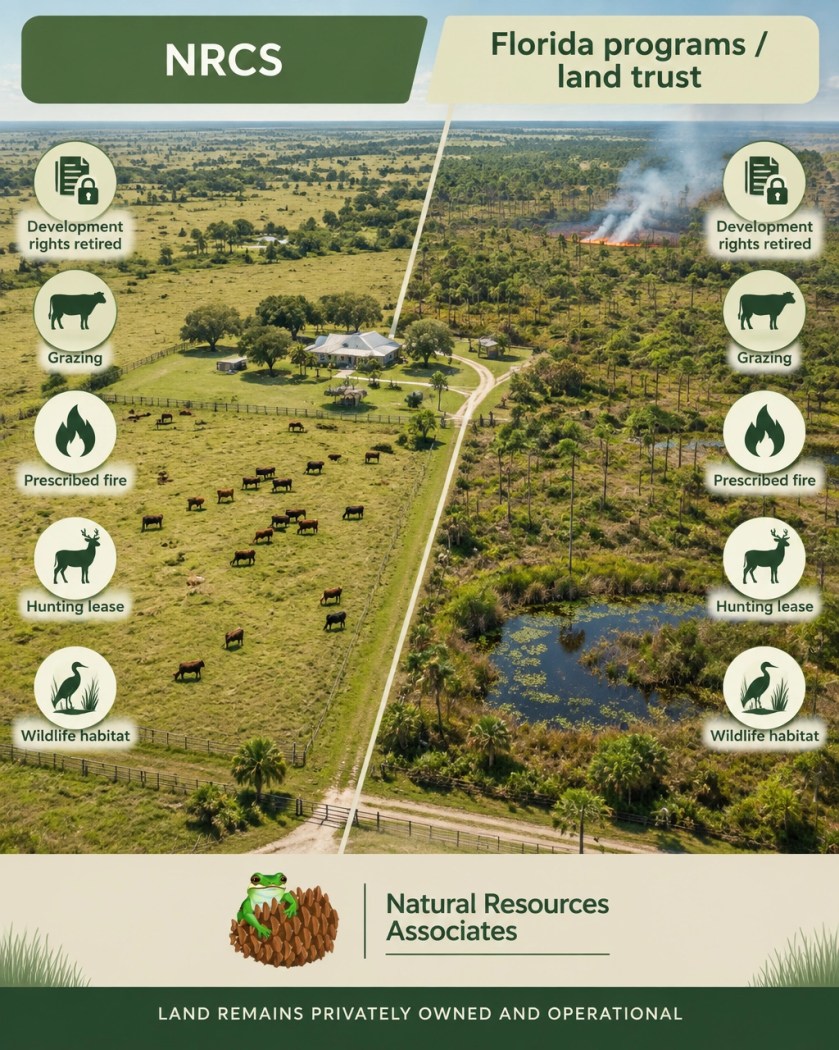
Illustration: A conservation easement can protect development rights while allowing compatible ranch management to continue.

Photo credit: UF/IFAS Extension.